
Redesigning Work in the Intelligent Age with First Principles
Technology is forcing organizations to confront an uncomfortable question:
Why do we operate this way in the first place?
For decades, organizations have used technology to improve existing processes. Each new wave of innovation promised faster execution, greater efficiency, and lower costs. Most of the time, the underlying work remained largely unchanged. AI presents a different opportunity.
Rather than simply accelerating work, AI gives organizations a reason to challenge assumptions about how work should be done in the first place. This is the essence of first-principles thinking: questioning assumptions, identifying fundamental truths, and rebuilding from what is truly necessary. In the age of AI, that mindset may become one of the most important competitive advantages an organization can develop.
The distinction may define the difference between incremental improvement and true transformation.
The Automation Trap
Organizations that focus exclusively on automation risk becoming more efficient at processes that may no longer be necessary, or that were designed around constraints that no longer exist. Most business processes were not designed from first principles. They evolved over time through layers of policies, approvals, handoffs, organizational structures, and technology limitations. Many made sense when they were created. Some no longer do.
AI is forcing organizations to examine which assumptions still create value and which simply create friction. The most transformative opportunities often emerge when leaders stop asking:
“How can we do this faster?”
and start asking:
“Why are we doing it this way at all?”
Why First Principles Matter More Than Ever
The concept of first-principles thinking dates back to Aristotle and has since been embraced by innovators across industries. The approach is deceptively simple:
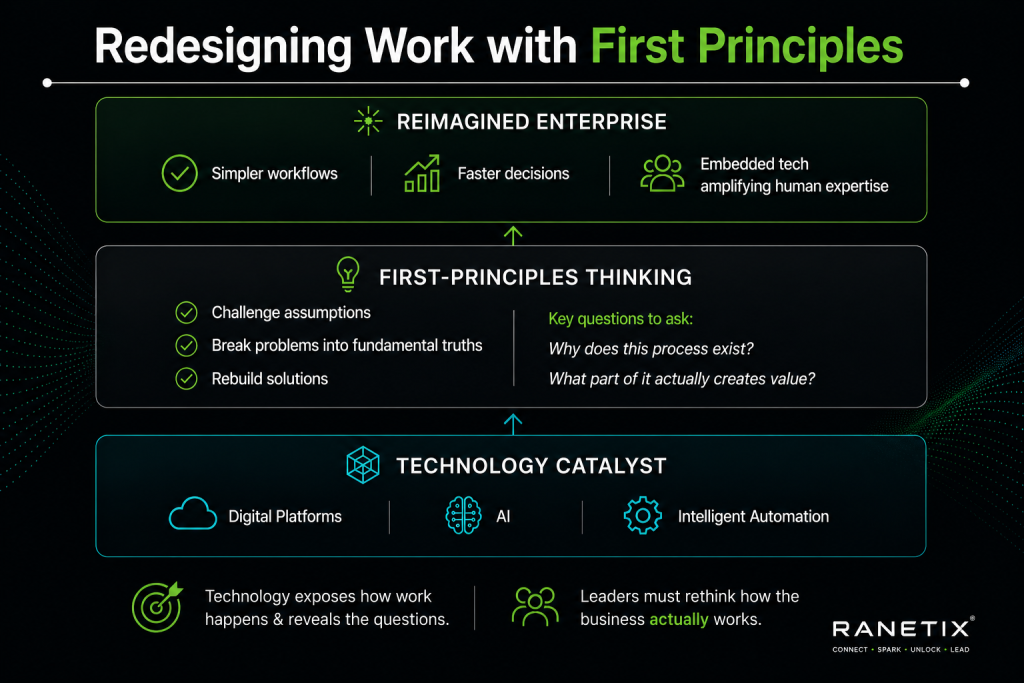
- Challenge assumptions
- Break problems into fundamental truths
- Rebuild from what is truly necessary
Rather than optimizing around existing constraints, first-principles thinking questions whether those constraints should exist at all.
AI is creating a unique opportunity to apply this mindset across the enterprise. Processes that once seemed fixed suddenly become flexible. Workflows that evolved over decades can be redesigned. Decision-making structures can be simplified. Entire operating models can be reconsidered. The question shifts from improving the process to understanding the outcome the process was intended to achieve.
Technology Is the Catalyst. Leadership Creates the Value.
One of the most important misconceptions surrounding AI is that the technology itself creates transformation. It doesn’t. Technology exposes possibilities. Leadership determines whether organizations act on them. AI can reveal inefficiencies, bottlenecks, unnecessary handoffs, and outdated workflows. It can accelerate analysis, automate tasks, and augment decision-making. But technology alone cannot challenge assumptions. That requires leaders willing to ask difficult questions.
- Why does this process exist?
- What part of it actually creates value?
- If we were building this from scratch today, would we design it the same way?
The answers often uncover opportunities that were hidden in plain sight.
From Workflows to Outcomes
Many organizations are still focused on improving workflows. The organizations creating the greatest value are increasingly focused on outcomes. Rather than asking how to optimize every step, they ask what outcome the customer, employee, or business actually needs. This shift often leads to simpler processes, faster decisions, fewer handoffs, and more effective use of technology. The goal is no longer to automate work. The goal is to redesign work. That distinction is subtle, but powerful.
The Future of Work Is Really the Future of Operating Models
When people discuss the future of work, the conversation often centers on jobs, skills, and productivity. Those topics matter. But the larger opportunity lies in reimagining how organizations operate. The next generation of high-performing organizations will not simply layer AI onto existing ways of working. They will rethink workflows, decision-making, governance, and organizational structures around what is now possible. In many cases, AI will be the catalyst. The operating model will be the differentiator.
The Leadership Opportunity
Every generation of technology creates new possibilities. Few create an opportunity to revisit so many long-held assumptions at once.
The organizations that create the most value from AI will not simply automate the way they work today. They will use this moment to challenge assumptions, rethink constraints, and redesign how the business should work tomorrow.
That requires curiosity.
It requires courage.
And perhaps most importantly, it requires leaders willing to ask a deceptively simple question:
Why do we operate this way in the first place?
In many ways, the future of work will belong to organizations willing to return to first principles.
Because before you can redesign work, you have to be willing to question why it exists the way it does today.
More From Ranetix: https://www.ranetix.com/ai-progression-framework