
The Human Advantage in the Intelligence Age
For more than five decades, organizations have invested in digital technologies to improve productivity, automate processes, connect information, and accelerate decision-making. Computers transformed offices. The internet connected the world. Mobile devices put technology in every pocket. Cloud computing made innovation scalable. Data became a strategic asset.
At the time, each wave felt transformative. Yet viewed through a different lens, these advancements may have been preparing us for something larger.
The Digital Age was not the destination. It was the foundation. The Intelligence Age is beginning.
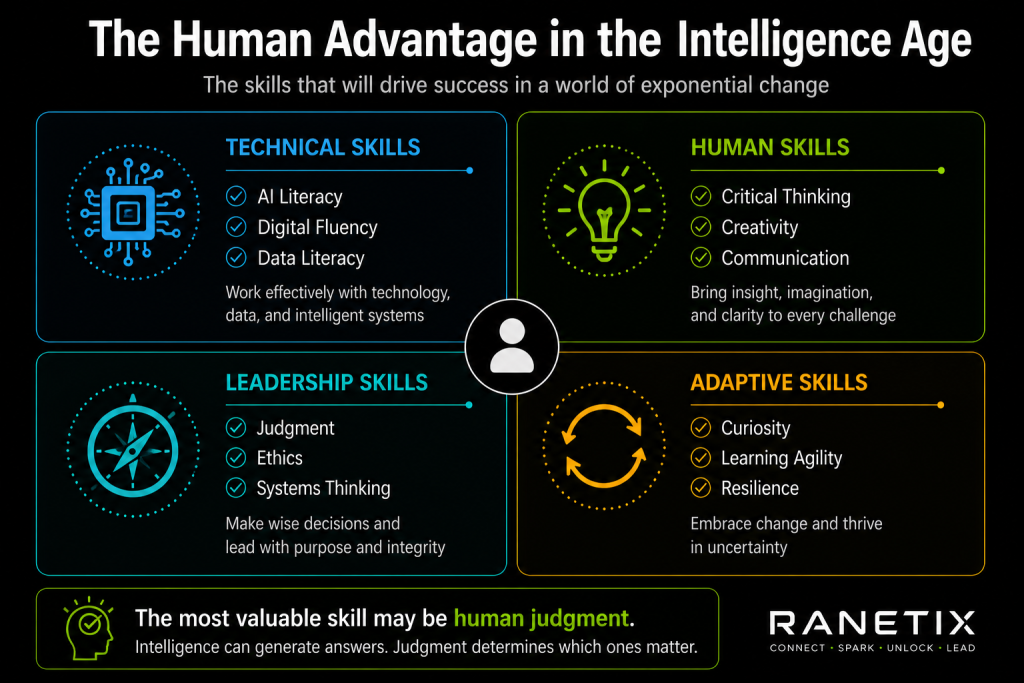
The Intelligence Age will reward organizations and individuals that combine technical fluency with uniquely human capabilities. The framework below highlights the skills most likely to differentiate leaders, teams, and institutions in the years ahead.
A New Kind of Transformation
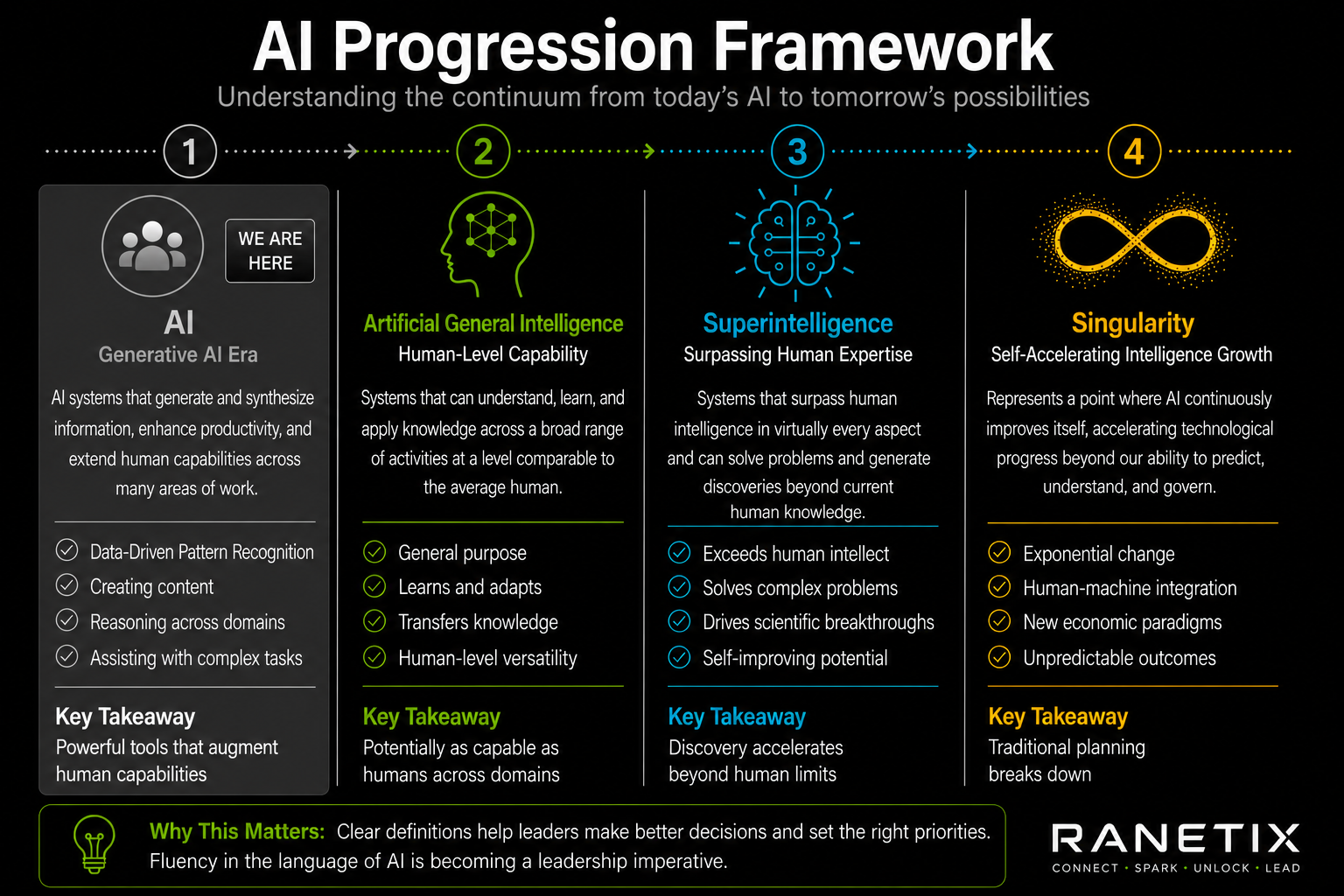
Previous technology revolutions primarily changed how work was performed. Artificial intelligence is beginning to change how knowledge itself is created, analyzed, and applied. For the first time, machines can assist with activities that were once considered uniquely human:
- Writing
- Research
- Analysis
- Problem solving
- Software development
- Content creation
- Decision support
This creates understandable questions:
- What skills will remain valuable?
- How should organizations prepare?
- How do individuals remain relevant?
The answer is not to compete with AI. The answer is to become better at what makes humans uniquely capable.
The Shift from Information to Judgment
For decades, access to information created advantage. Today, information is abundant. Tomorrow, the differentiator will increasingly be judgment. Knowing facts matters. Knowing what to do with them matters more.
As AI becomes increasingly capable of generating answers, human value shifts toward asking better questions, evaluating context, exercising judgment, navigating ambiguity, and making decisions.
Technical skills will remain important. Human capabilities will become even more important. As intelligence becomes increasingly accessible, judgment becomes increasingly valuable.
The Exponential Mindset
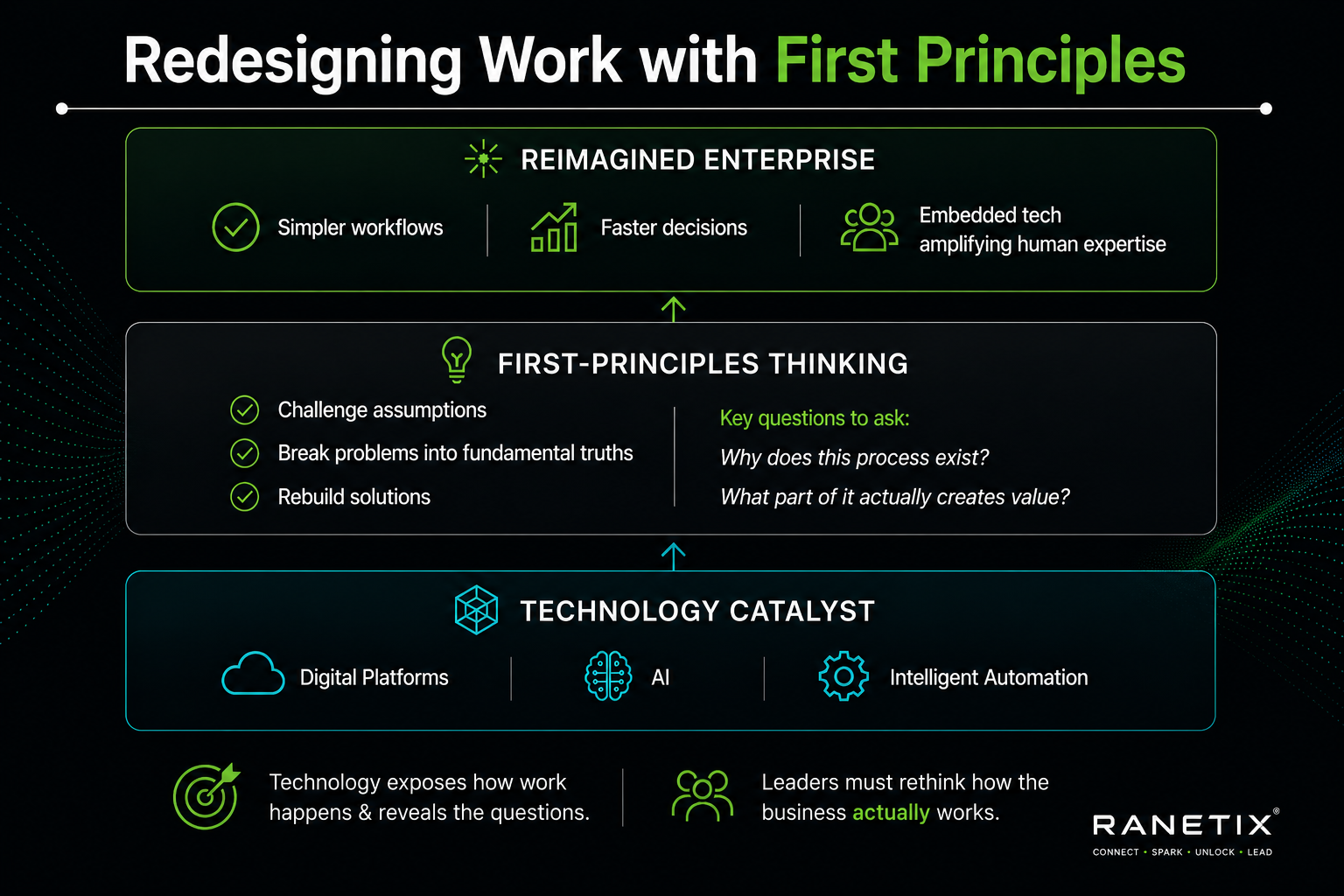
One of the greatest challenges facing organizations is that technology advances exponentially while human systems tend to evolve incrementally.
Processes evolve slowly. Organizational structures evolve slowly. Educational models evolve slowly. Mindsets often evolve slowest of all.
The leaders and organizations that thrive in the Intelligence Age will develop what can be described as an exponential mindset. An exponential mindset embraces continuous learning, challenges assumptions, remains curious, and adapts quickly as technology evolves. It recognizes that yesterday’s expertise may not be sufficient for tomorrow’s challenges.
Most importantly, it views change as an opportunity rather than a threat. Curiosity becomes a strategic advantage because the leaders who ask better questions are often the first to recognize new opportunities.
What Schools and Universities Should Be Teaching
Many educational systems were designed for an industrial economy and later adapted for a knowledge economy. The Intelligence Age requires another evolution.
Technical literacy will remain important, but future success will increasingly depend on capabilities that are difficult to automate. Four categories of skills will become increasingly important as intelligent systems continue to evolve:
- Technical Skills: Digital and AI literacy, Data literacy, Fundamental tech architecture literacy
- Human Skills: Critical thinking, Creativity, Communication, Collaboration
- Leadership Skills: Systems thinking, Ethical reasoning, Problem framing
- Adaptive Skills: Adaptability, Learning agility, Fearless curiosity
Students should learn how to work and think with intelligent systems, not simply how to use technology. The goal is not to produce graduates who can compete with AI. The goal is to produce graduates who can amplify their capabilities through AI.
What Organizations Should Be Building
The same principles apply in the workplace. The organizations that thrive will not be those with the most AI tools. They will be those with cultures that learn, adapt, and evolve faster than their competitors.
This requires more than technology investment. It requires investment in people. Leading organizations are increasingly focusing on:
- Technical Skills: AI and Digital fluency
- Human Skills: Critical thinking, Creativity, Communication, Collaboration
- Leadership Skills: Judgement, Decision quality, Human-centered leadership
- Adaptive Skills: Continuous learning, Experimentation, Change adaptability
The most important workforce strategy may no longer be hiring for today’s skills. It may be developing the capacity to learn tomorrow’s skills.
Culture Becomes a Competitive Advantage
Technology can be purchased. Culture cannot. As AI capabilities become more accessible, organizational culture will become an even greater differentiator.
Organizations that encourage curiosity, experimentation, learning, and responsible risk-taking will adapt faster than those that rely on rigid structures and historical ways of working.
The future will reward adaptability. Adaptability is ultimately a cultural capability.
The Human Advantage
The Intelligence Age will undoubtedly change work. Some tasks will disappear. New roles will emerge. Entire industries will evolve.
This is not the first time humanity has faced technological disruption, and it will not be the last. What has consistently separated successful individuals and organizations is their willingness to learn, adapt, and reinvent themselves.
Technology will continue to become more intelligent. The question is whether we will become more adaptable. The question is whether we will become more adaptable, more curious, and better at exercising judgment. Because in the Intelligence Age, the greatest competitive advantage may not be artificial intelligence. It may be uniquely human capabilities amplified by it.
Intelligence can generate answers. Judgment determines which ones matter.